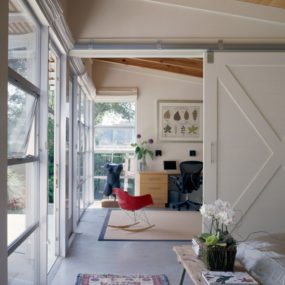
You know the house. It’s June, the windows are wide open, and the whole living room just feels like summer the second you walk in. Nothing looks fussy. Nothing looks staged. It’s just lighter somehow.
You’ve probably tried to figure out what she’s doing. You traded heavy winter curtains for airy linen ones like every summer guide told you to. Put the chunky throw blankets away. Swapped in lighter pillow covers. And your room still doesn’t feel the way hers does.
Which is confusing, because you did the list. So what’s she doing that you’re not?

It isn’t a trick, and it isn’t taste
The strangest part is that when you walk into her house, you can’t point at what’s different. You can’t say “it’s the wall color” or “it’s the couch.” Nothing obvious is new. She hasn’t repainted. She hasn’t rearranged the furniture. The couch is the same couch it was in December.
And yet the room feels ten degrees cooler before you even sit down.
If you asked her, she’d probably shrug and say something like “I just swap a few things out.” That answer is honest but it hides the important part. Because most people, when they hear “swap a few things out,” picture the same list you already tried. Curtains. Pillows. Maybe a throw blanket. Maybe a candle.
What those things have in common is that they’re the small stuff. They’re the pieces every summer article talks about, because they’re the pieces designers know the average homeowner will change. They’re also the pieces that add up to a small share of what your eye actually sees when you walk into a room.
Think about it for a second. Your curtains cover the windows, sure. But the windows are one part of one wall. Your pillows sit on the couch, which is one piece of furniture. The blanket, when it’s out at all, is a folded rectangle on an armrest.

Now think about the biggest piece of fabric in the whole room. The one that stretches across most of the floor. The one your eye lands on the moment you step through the doorway, whether you notice you’re looking at it or not.
That one almost never gets swapped. In most American homes it sits there year-round, doing the exact same job in January and July.
Which is strange when you say it out loud. If you’d never change your winter coat for your summer wardrobe, why would you leave the biggest fabric in your house on the same setting all twelve months?
The blind spot every summer guide misses
Interior designers who style homes for a living know this. It’s not a secret in their world. It just doesn’t make it into most seasonal decor articles because everyone assumes this piece is a permanent, one-time purchase. You buy it once when you move in and you’re done for a decade.
That assumption is the whole problem.
Because in most homes, this piece was picked for looks and warmth. It’s dense. It’s plush. It has depth. It does the thing you want a floor covering to do in the middle of winter, which is trap heat and make a bare wood floor feel less cold under your feet. It reads cozy.
But cozy is a winter word. And when the calendar flips to June, that same piece is still doing its winter job. Still trapping heat. Still soaking up light instead of bouncing it back. Still visually heavy, sitting there in the middle of a room where everything else has been lightened up.
You changed everything above the floor. The floor stayed winter. That’s the mismatch your eye picks up every time you walk in.
That’s why the room feels stuck, no matter how many linen curtains you hang. She figured that out. Most people haven’t.
And once you notice it, you can’t stop noticing it. You’ll walk into a friend’s house in July and clock it inside of five seconds. Airy curtains, breezy pillows, thick winter floor. The room is fighting itself.
The reason “her” home doesn’t fight itself is that she took the same rotation logic you already apply to curtains and pillows and pushed it down one level. To the biggest fabric surface in the room.
What she actually does (and how to copy it)
She keeps a second rug. That’s the whole trick.
Not a fancier rug. A different kind of rug that rotates in for the warm months while the winter one goes into storage. Doing this well comes down to a few specifics that separate “did it right” from “ruined a $300 rug in one season.”
Buy the summer rug in the same size as your winter one. This rule is what makes the whole thing work. If your winter rug is 8×10 feet (roughly 240 x 300 cm) anchoring your sofa and coffee table, your summer rug needs to be 8×10 too. Same footprint means the swap is a straight rotation. No moving furniture. You roll one up, roll the other out, done in twenty minutes.
Pick the summer material based on the room:
- Flatweave cotton. Softest option. Good for bedrooms and family rooms. Often machine washable.
- Jute. That warm, golden, natural look most people picture when they hear “summer rug.” IKEA’s LOHALS is the famous cheap version, around $130 for an 8×10 (about 120 euros). Sheds for the first couple of weeks. Skip it in bathrooms.
- Sisal. Tighter and cleaner-looking than jute. Great for entryways and formal living rooms.
- Seagrass. The smoothest natural fiber, with a slight sheen. Handles humidity better than jute.
The physics is simple. Rugs Direct notes that thick wool rugs trap warmth in cold months, while breathable materials like cotton, jute, or sisal help keep temperatures comfortable in summer, and Revival Rugs adds that a flat, breathable weave is a real advantage in warmer climates or sun-soaked rooms.
Store the winter rug the right way, or you’ll wreck it. Don’t fold it. Not even once.
Extra Space Storage’s rug guide says it flat out: to prevent creases, cracks, and other damage to the fibers and backing, you should never fold a rug or carpet, and should roll it into an even cylinder instead. Worldwide Flooring warns that on wool, folding creates permanent creases and can crack the backing. That $300 rug becomes a $0 rug the day you fold it in half and shove it in a closet.
Do this instead:
- Vacuum both sides and let it dry fully before rolling. Trapped moisture turns into mildew.
- Roll it into a tight cylinder along the grain, pile facing inward.
- Wrap it in a breathable cotton or linen rug bag ($20 to $40, about 20 to 40 euros). Never plastic. Plastic traps moisture and gives you a musty smell that doesn’t come out.
- For wool, tuck in a couple of cedar blocks. Moths eat wool fibers.
- Store it flat under a bed or on a closet shelf. Garage or basement only if climate-controlled.
The payoff
Come summer, your room reads the way hers reads. Light bounces off the floor instead of getting swallowed by it. The whole space feels lighter and cooler before you touch a fan. When October rolls back around, you unroll the plush winter one and the room goes cozy again in the time it takes to pour a coffee.
One-time cost: one rug, $80 to $400 (about 75 to 375 euros). The rotation is free forever after that.
Sources: (1) Jaipur Living; (2) Rugs Direct; (3) Revival Rugs; (4) Extra Space Storage; (5) Worldwide Flooring.