
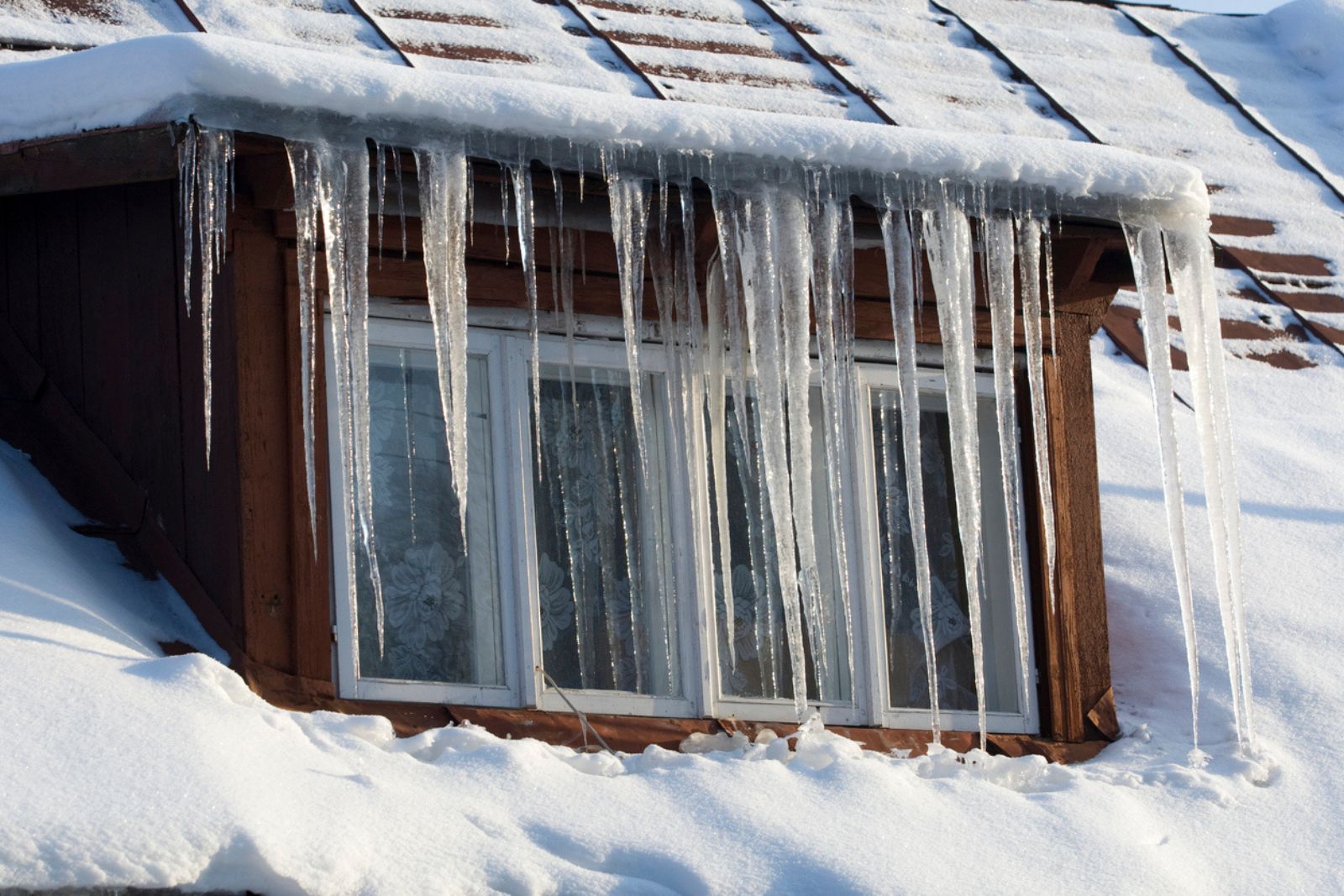
After the first real snowfall, a row of icicles appears along the edge of the roof. They look pretty in the morning light, so you leave them alone. A few weeks later, a brown stain shows up on the ceiling near an outside wall, and the paint starts to bubble.
This is not your fault. It’s easy to see icicles as winter decoration, not a warning. But Travelers, the insurance company, notes that “icicles can be a precursor to ice dams.” An ice dam is a ridge of ice at the edge of the roof that traps melting snow behind it. When that water has nowhere to go, it can back up under the shingles and into the house.
Table of Contents
Why ice builds up at the edge of the roof
The problem usually starts in the attic, not on the roof. Ken Hellevang, an engineer with North Dakota State University Extension, explains that heat loss from the home into the attic, through openings and gaps in the insulation, is a major cause of snowmelt. The warm roof deck melts snow from below. The water runs down the roof, and when it reaches the colder eaves, it freezes again.
Each melt and freeze makes the ridge thicker. Eventually, as Travelers explains, the ice can grow large enough to stop meltwater from draining, so it backs up under the shingles. Water stains or moisture in the attic or along the ceiling of exterior walls may mean that an ice dam has formed and water has gotten in.
How homeowners prevent ice dams
The goal is to keep the roof cold and the snow load light. Here is what the sources recommend:
- Seal air leaks into the attic. Hellevang points to openings where plumbing, heating or electrical components protrude into the attic that aren’t sealed properly. A Massachusetts state guide on ice dams also recommends sealing attic air leaks so warm air doesn’t reach the roof deck, and suggests a home energy assessment to find them.
- Add attic insulation. According to Hellevang, attics in northern climates need a minimum of roughly 15 inches of blown-in insulation, or an insulation value of R-50.
- Keep the soffit vents open. Hellevang recommends baffles that hold insulation back from the soffit vents so air can flow.
- Clean the gutters before winter. The Massachusetts guide lists clearing gutters as a preventive step, along with a waterproof membrane under the roofing where water tends to collect.
- Rake the snow off the lower roof. Travelers suggests using a roof rake from the ground to remove snow 3 to 4 feet from the edge of the roof after a storm.
- Melt a channel, carefully. If a dam has already formed, Travelers recommends a calcium chloride ice melt product and warns against rock salt or sodium chloride, which can damage the roof. Cover nearby shrubs with lightweight tarps.
Hellevang cautions against relying on fixes like heat tape that treat the symptom instead of the cause. Insulation and air sealing do the long-term work. And if you’d rather have icicles that only look the part, the icicle lights in these Christmas porch ideas are a safer way to get the effect.
When to stay off the ladder
Don’t climb onto a snowy roof. The Massachusetts guide warns that climbing onto the roof or chipping at ice from the ground is dangerous and can damage the roof, and notes that falling ice can be fatal. Travelers adds that, depending on their size and location, icicles can be dangerous if they fall.
When using a roof rake, Hellevang says to watch for overhead power lines. If you can’t safely reach the roof or the icicles from the ground, Travelers suggests hiring a contractor. If ice dams keep coming back after you’ve added insulation and sealed leaks, the Massachusetts guide recommends consulting a building professional about attic ventilation. Coverage for water damage varies by policy and state, so check your own contract. This is not insurance advice.
Seal the attic, insulate the floor of it, and pull the snow off the edge. That’s the trick.
WHAT DO YOU THINK?