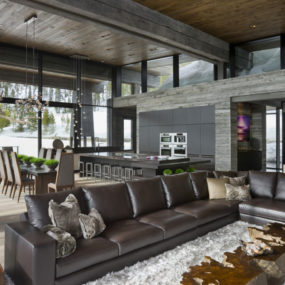
You did everything right. You measured the room. You skipped the tiny 5×7 (150×210 cm). You bought the 8×10 (240×300 cm) rug every buying guide told you to buy. The front legs of your sofa are on it. The front legs of your chairs are on it. On paper, you followed the rule.
And your living room still looks a little off.
The couch and the chairs feel like separate pieces of furniture that just happen to be near each other. Guests don’t say anything, but you notice it every time you walk in. The room doesn’t feel like a room. It feels like stuff arranged in a room.
So you start second-guessing everything else. Wrong paint color? Wrong sofa? Should you move the coffee table? Add another lamp? Maybe swap the throw pillows? You’ve tried three or four small fixes by now, and none of them changed the feeling.
You go back and read the rug rule one more time, because that’s the part you’re most sure about. Front legs on the rug. Yep, they’re on. Rug is centered under the coffee table. Yep. Everything checks out. So why does it still feel wrong?
The rug is the reason. But not in the way you think.
Because the rule you followed is the rule everyone follows, which means the flat-looking result you got is the result most people get. Scroll through any real home tour on Instagram and count how many living rooms have that same off, not-quite-there feel. Same rule, same result.

The rule everyone repeats
Open any rug buying guide and you’ll get the same instruction. Rugs Direct says to “decide whether front or all legs should sit on the rug.” Sofatica calls “at least the front legs” the rule that “eliminates 90 percent of rug-sizing mistakes.” Home Depot’s how-to on picking an area rug describes the 8×10 (240×300 cm) as the size for a rug “slightly smaller than your furniture arrangement,” with just the front legs on top.
So you’re not wrong. You followed real, mainstream, professional advice.
And that’s the trap. The front-legs-on rule exists to save you from the worst rug mistake there is, the one designers call the floating furniture problem. That’s when the rug is so small it sits under the coffee table like a bath mat, and every piece of seating is stuck on bare floor around it. Designer Katie Nelson told Parade: “The most common mistake I see homeowners make is using too small of a rug.”
Front-legs-on saves you from that. It ties the sofa and chairs to the rug so nothing looks stranded. That’s a real win, and it’s why every guide leads with it.
But saving you from the worst mistake isn’t the same thing as giving you a finished room. The advice is a floor, not a ceiling. And once you’ve cleared the floor, nobody tells you what to do next. Most people never find out there is a next step, which is why so many living rooms get stuck at “technically correct but somehow flat.”
What’s actually going wrong in your room
Look at the space between your sofa and the chairs across from it.
A regular three-seat sofa is about 84 to 96 inches wide (215 to 245 cm). Accent chairs are about 30 to 36 inches across (75 to 90 cm). Put an 8×10 rug in the middle of all that, and the math gets tight fast. The rug catches the front legs. But the back legs of the sofa and the back legs of the chairs are on bare floor, and the outside edges of every seat are hanging off the rug.
And this is the part nobody explains: your eye follows the strongest line in a room. And the strongest line in your setup is the edge where the rug ends and the bare floor begins. That line is cutting straight through the middle of your seating.
Designer Lena Torres, quoted in an Oreate piece on rug scale, put it plainly: “Scale is everything.” When the rug is too small for the group, “our eyes tend to notice that empty space around the rug, and it can make the room feel disjointed.”
That’s what you’re feeling. Not ugly. Just off. You didn’t fail the advice. The advice ran out.
A quick honesty check first
If you live in a small apartment or a room under about 11 by 12 feet (3.4 by 3.7 m), the front-legs-on rule with an 8×10 is actually the right call for you. Atlanta Designer Rugs points out that going bigger in a small room just crowds the space.
This piece is for the much bigger group, with a normal 12×14, 13×16, or 14×18 living room (roughly 3.7×4.3 m, 4×4.9 m, or 4.3×5.5 m). Room to spare, but you followed the front-legs rule anyway. If that’s you, keep reading.
What designers actually do in their own homes
The upgrade isn’t a whole new rule. It’s the next rule, the one most guides mention in passing and then walk away from.
Every leg of every seat sits on the rug. Not just the front two. All four.
Keck Furniture puts it simply: “If your room has the space, putting all furniture legs on the rug creates the most finished, ‘designed’ look and helps the seating area feel larger and more unified.” Parade‘s Katie Nelson agrees: “Ideally, all four legs of your sofa (or at least the front legs!) should be on the rug.” Longley, in the same piece: “Ideally, all furniture should sit all the way on the rug.” Every one of them treats front-legs-on as the okay version and all-legs-on as the right version.

And here’s what changes: the seating finally feels like one connected group instead of separate pieces floating near a rug. The line where the rug meets the floor moves out past all your furniture, so your eye stops tripping over a break running through the middle of the room. It’s not about covering more floor. It’s about moving that line to where it belongs, out at the edges of the room, instead of letting it slice through your couch.
The size that actually gets it done
For a normal 84 to 96 inch sofa (215 to 245 cm) with two accent chairs facing it, the size that fits all four legs on for the whole group is almost always a 9×12 (275 by 365 cm), sometimes a 10×14 (305 by 425 cm) if the room can hold it. Rug Branch backs this up: a 9×12 is what steps in “when an 8×10 still looks slightly tight around the seating group.”
Grab a tape measure. Two minutes:
- Measure across your seating area, from the outside edge of one piece to the outside edge of the piece across from it. That’s your minimum rug length.
- Add at least 12 inches (30 cm), so the rug sticks out 6 inches (15 cm) past each outer leg.
- Leave 12 to 18 inches (30 to 45 cm) of bare floor between the rug and the walls. That’s the standard designer margin.
- If your numbers land between two sizes, size up, not down. Homebaa is blunt: “If your living room is small, don’t shrink the rug to match.”
- Don’t buy the rug that only just fits under the coffee table. That’s the 5×7 mistake in disguise.
Front-legs-on keeps your room from failing. All-legs-on is what makes it feel finished.
Sources: (1) Rugs Direct; (2) Sofatica Rug Size Guide; (3) Home Depot; (4) Parade; (5) Oreate design blog on rug illusion; (6) Atlanta Designer Rugs 8×10 sizing guide; (7) Keck Furniture; (8) Rug Branch 8×10 sizing guide; (9) Homebaa Rug Size Guide and Calculator.